Practice Points
- Although the Expanded Disability Status Scale (EDSS) is a widely accepted prognostic tool for multiple sclerosis (MS), it has been criticized for its poor reliability and limited sensitivity to changes in certain aspects of disease progression.
- Using prognostic factors beyond the EDSS may improve patient care and inform future trials in MS. Specifically, supplementing the EDSS with patient-reported physical measures, assessing fatigue, and using simultaneous cognitive and motor function testing may help in gauging MS disease progression.
Multiple sclerosis (MS) is a chronic neurologic disease wherein overactive immune cells cause inflammation, demyelination, and axonal damage in the central nervous system. The resulting degenerative disease course requires accurate, sensitive, and comprehensive measures for the purposes of monitoring progression and making patient care decisions.
The Expanded Disability Status Scale (EDSS), an ordinal, clinician-administered assessment scale with scores ranging from 0 to 10, is widely used to assess the status of patient disability in MS. Short-term sustained changes in disability status are often reported in terms of confirmed disability progression (CDP), the presence of which corresponds to an increase in EDSS score maintained on repeated evaluation at 3 to 6 months. However, several studies have criticized the EDSS and CDP for limitations related to their prognostic value, including lack of accuracy, limited sensitivity to change at certain disability levels of the disease, focus on physical ability, and nonstandardized interpretability.1–3 As a binary indicator, CDP in particular may offer limited value for prediction of disability progression. Although the EDSS does have some predictive value, certain aspects, such as intrarater and interrater variability, leave room for improvement.4,5 Given these limitations, there is a need for expansion in the tools used to gauge disease progression in clinical practice as well as clinical trials evaluating the efficacy of new MS treatments.
In this narrative review, we first summarize the available evidence of the predictive power of a select number of commonly used measures to assess MS progression. The goal of this review is not a systematic assessment but rather a targeted review of recent literature that focuses on specific end points related to MS progression. We then discuss available evidence on key limitations of the EDSS as a prognostic measure and highlight some measures that may assist in improving the sensitivity of this scale in the clinical management of MS. We highlight general viewpoints from a panel of 4 experts in MS research (the authors [B.W.-G., M.P.S., P.R.] and Dr Enrique Alvarez of the University of Colorado) convened at the 2019 European Committee for Treatment and Research in Multiple Sclerosis meeting in Stockholm, Sweden, held September 13 to 19, 2019. At this meeting, the panel discussed the utility of clinical methods currently used to predict and monitor MS progression and suggested general directions for future studies that might help clinicians effectively monitor MS disease worsening.
Targeted Literature Review of Prognostic Measures
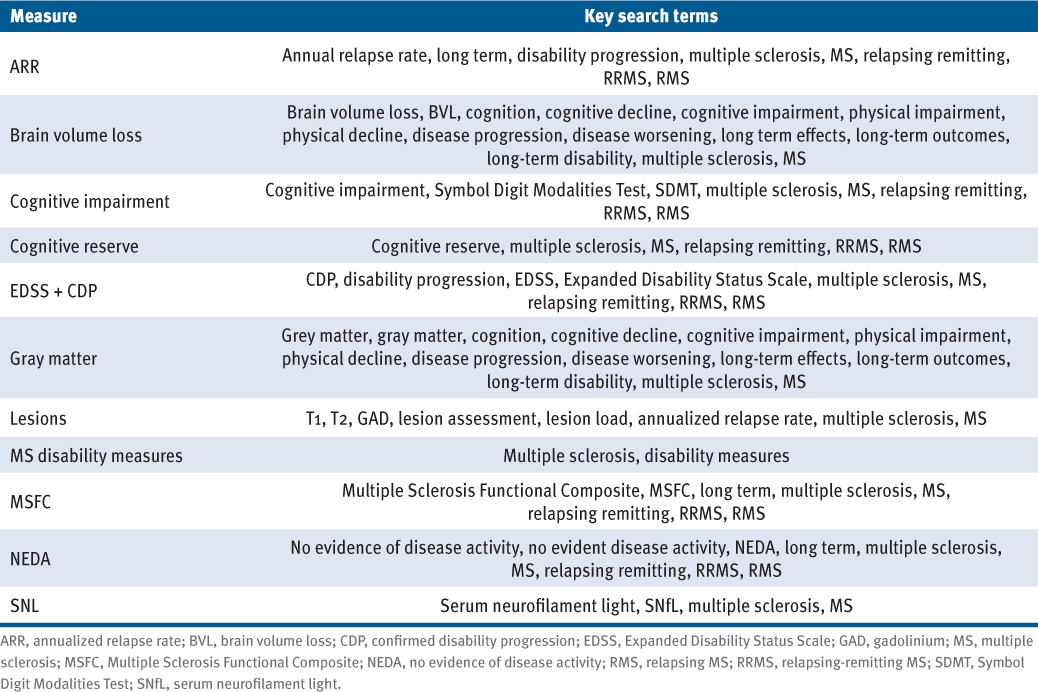
Before the expert panel discussion, a targeted literature review using ProQuest and Google Scholar was conducted to identify evidence on prognostic measures other than the EDSS that may be predictive of long-term MS disease progression. The targeted literature review largely focused on articles published between 2014 and 2019, although articles published before 2014 were included to capture relevant evidence. Articles not published in English were excluded from consideration. All identified studies were screened, reviewed, and synthesized based on the following measures: no evidence of disease activity; EDSS and CDP; brain volume loss; gray matter; white matter; lesions; serum neurofilament light; cognitive impairment; pregnancy and demographics, specifically age, sex, and education; relapse and annualized relapse rate; disease duration; macular volume; and Montgomery-Åsberg Depression Rating Scale. A summary of key search terms associated with each measure is provided in Table 1.
The impact of each measure used to assess the progression of MS and the patient populations evaluated are summarized in Table S1, which is published in the online version of this article at IJMSC.org. The evidence varied regarding each measure’s utility in assessing disease progression. Among the studies that met the inclusion criteria, the evidence regarding the predictive power of no evidence of disease activity and minimal evidence of disease activity was generally inconsistent.5–9 Brain volume loss generally showed positive predictive power on long-term MS progression, particularly regarding increases in EDSS score10 and assessments that combine brain atrophy and retinal thinning.11 Although assessments of gray matter reductions were also predictive of MS progression, the evidence was partially based on associations and correlations.12,13 Similarly, there was some evidence supporting the predictive power of white matter on long-term disease progression, but it was based on associations.12 Limited evidence was available in favor of the predictive power of other measures of brain volume, such as cerebrospinal fluid, parenchyma,12 and ventricular fractions,14 as well as macular volume.15 Cognitive impairment,16 demographic characteristics (age, sex, education),12,14,16 and measures assessing lesion volume,10,14,17 serum neurofilament light,18 and disease duration12,16 did not consistently predict disease progression, particularly in the long-term. Although the evidence was mixed regarding the predictive power of annualized relapse rate,16 there was some evidence to support the predictive power of relapse on long-term disease progression.5 There was also some evidence to support the predictive power of pregnancy on long-term disease progression; however, the research was largely based on congress presentations.19 The Montgomery-Åsberg Depression Rating Scale was found to have no predictive power in long-term assessments of MS progression.14
The EDSS
Limitations as a Prognostic Measure
There is ample evidence supporting the limitations of the EDSS as a prognostic measure. Foremost, the EDSS is meant to function as a measure of irreversible disability in MS; however, the literature shows that it fails to serve this basic purpose.1–3 Recently, the placebo arms of 31 randomized controlled trials in relapsing-remitting MS and secondary progressive MS patient populations were analyzed, and the results showed significant rates of EDSS score improvement, sometimes as high as rates of EDSS score worsening.1 To further illustrate the inaccuracy and instability of this instrument, the EDSS has been shown to overestimate the accumulation of permanent disability by up to 30%.3 The EDSS also has plateau scores at 6.0 and 6.5, that, over time, has discouraged researchers from including patients with these scores in clinical trials, given the need to quantify change in progression.
Inaccuracies Associated With Use
Further evidence shows that increases in EDSS scores do not accurately identify patients with irreversible long-term disease progression. A study conducted in persons with relapsing-remitting MS assessed multiple definitions of sustained progression using the EDSS.2 Between 15.8% and 42.2% of these individuals had sustained progression across 3.7 years, but nearly 50% of them did not maintain progression for the duration of follow-up.2 Relapses or changes in provider could not explain the poor performance of the EDSS,2 suggesting that the use of the EDSS score and the CDP to measure outcomes for clinical trials or observational studies could lead to incorrect conclusions due to the potential instability of EDSS scores.
The EDSS has also been criticized for not being a comprehensive measure of all dimensions of MS.20 Whereas lower scale values are influenced by impairments detected by a neurologic examination, values higher than 4 are mainly based on walking ability, and values higher than 6 are based on patient handicaps.21 The EDSS does not adequately capture the dimensions of cognition, upper extremity function, or fatigue, which are believed to be relevant predictors of long-term disease progression in MS.16,22,23 Moreover, studies recommend separate consideration of the lower and upper value ranges of the EDSS because EDSS scores of 6 and higher are less sensitive to change in disease severity.24,25 The evidence on the prognostic limitations of the EDSS across several domains highlights the scope for improved prediction of long-term disease progression in MS.
Panel’s Viewpoints on Alternative Prognostic Measures to the EDSS
Because of the potential prognostic limitations of the EDSS, it is the panel’s opinion that alternative measures are needed to better classify disease severity and assess disease progression in patients with MS. Although there is a large and growing body of evidence on the prognostic value of factors beyond the EDSS, there is no widely held understanding of whether these factors improve predictions of long-term disability beyond the EDSS. To detect clinically meaningful changes in patients with MS, prognostic measures will need increased reliability and sensitivity. To these ends, current research suggests that approaches incorporating fatigue and lower limb function, as well as combination measures, either as a supplement or alternative to the EDSS, may be promising avenues to explore. In the following sections, we provide literature to support the panel’s viewpoints on alternative prognostic measures to the EDSS.
Incorporation of Fatigue and Lower Limb Function
The related matters of fatigue and lower extremity dysfunction, including patient-reported leg weakness as well as functional limitation identified via examination, may be of particular interest among alternative measures of disease progression with promising predictive value.22 A preliminary study found that in older people with MS, fatigue and limited lower extremity function predicted conversion from relapsing-remitting MS to secondary progressive MS within 5 years.22 The study evaluated 155 persons aged 50 years or older with relapsing-remitting MS and a disease duration of at least 15 years. Fatigue was reported to be 4 times as likely in people with disease progression (92%) as compared to those without progression (68%).22 In addition, limitations in lower extremity function were reported to be 3 times as likely in people with disease progression at the beginning of the study (53%) compared with those who did not progress (22%).22 Researchers noted that although the precise cause of fatigue in patients with MS has not been fully established, it is most likely a result of the underlying complex inflammatory and neurodegenerative processes that characterize the disease, including sequelae from MS—demyelination, axonal injury, and inflammatory response—in addition to factors such as depression and sleep disturbances.26,27 Consequently, fatigue and lower extremity dysfunction may be more sensitive indicators of the extent of central nervous system injury, but they may not be fully assessed or gauged with high sensitivity during a short neurologic examination.
Use of Combination Measures to Supplement the EDSS
An alternative approach to improved prediction of disease progression could involve supplementing the EDSS with physical measures such as the Nine-Hole Peg Test (NHPT), the Timed 25-Foot Walk test, or the low-contrast letter acuity test.28–30 For example, the NHPT is commonly used in MS research and clinical practice and is considered to be a gold standard measure of manual dexterity, a frequent symptom reported by patients with worsening MS.23 Studies have indicated the consistently high interrater and test-retest reliability of the NHPT as well as its ability to distinguish patients with MS who have different levels of upper limb impairment.23 A 20% change in NHPT score is used to define clinically meaningful worsening; however, this definition needs further validation in all stages of the disease.23
Another potential avenue for future research is combining cognitive measures such as the Symbol Digit Modalities Test (SDMT) or the Brief International Cognitive Assessment for Multiple Sclerosis (BICAMS) with taxing motor tasks and walking tests.31,32 A 10-year retrospective longitudinal study reported cognitive impairment, measured by the SDMT, as a predictor of disability progression and secondary progressive MS conversion in patients with newly diagnosed relapsing-remitting MS.16 The study included 155 persons with relapsing-remitting MS, of whom 67 (43.2%) reached an EDSS score of 4.0, and 34 (21.9%) converted to secondary progressive MS during follow-up.16 Individuals with cognitive impairment at MS diagnosis were 3 times as likely to reach an EDSS score of 4.0 and 2 times as likely to convert to secondary progressive MS compared with cognitively preserved individuals.16
Last, the predictive validity of magnetic resonance imaging and clinical scoring assessments may help clinicians identify treatment failure and potentially assist with treatment optimization.33 For example, the Rio scoring system, which combines evidence of magnetic resonance imaging lesions, presence of relapse, and increases in EDSS scores within 12 months of treatment initiation, has been used to predict ongoing disease activity and, ultimately, which patients are at risk for a suboptimal response to therapy over time.33 The sum of each parameter (0–3) distinguishes a patient’s risk from low to high.33 The modified Rio score, a simplified version of the Rio score that excludes the EDSS score and modifies relapse and magnetic resonance imaging lesion criteria, has been reported to have a high positive predictive value of disease progression within 3 years of treatment initiation.33 Results from a longitudinal study validating the utility of the scoring system found that in 222 patients with relapsing-remitting MS treated with interferon, patients with a risk score of 0 had a 24% probability of MS progression, whereas those with a score of 2 or higher had their risk of progression increase to 65%.33
Direction for Future Studies
Although our current understanding of MS disease progression does not allow for a single most promising measure to be identified, research should continue to explore promising themes and measures to improve clinical and real-world assessments of MS treatments in the near term.34 An improved understanding of individuals at higher risk for disease progression may eventually result in more tailored treatment options for patients and establish an advanced approach to economic evaluations in MS.